
The Evolution of Body Contouring Technology: From Fat Destruction to Functional Restoration
- May 4
- 6 min read

Body contouring has always been shaped by one driving force: what patients want most right now. Ten years ago, that want was simple—“make this area smaller.” The industry responded with technologies designed to reduce fat as directly as possible, often treating fat like the only variable that mattered.
But patients have changed, and the science has caught up. Today, many patients don’t just want less volume. They want a body that looks finished: stronger, tighter, more defined, and more stable. They want change that holds up not only in a before-and-after photo, but in real life—standing, moving, aging, and maintaining results.
That shift has pushed body contouring into a new era. The most effective platforms are no longer built around reduction alone. They’re built around restoration—addressing fat, muscle, skin, and the tissue environment simultaneously.
This blog explains how we got here: the progression from fat-only devices to muscle stimulation to multi-modality systems, and finally to the modern standard—functional restoration, where the body is supported and rebuilt, not just reduced.
Era 1: The “Fat Reduction Only” Mindset
The first major wave of non-invasive body contouring was dominated by one metric: inches off. If a technology could reduce subcutaneous fat in a targeted area, it was considered successful. This made sense at the time because the aesthetic goal was largely framed as subtraction.
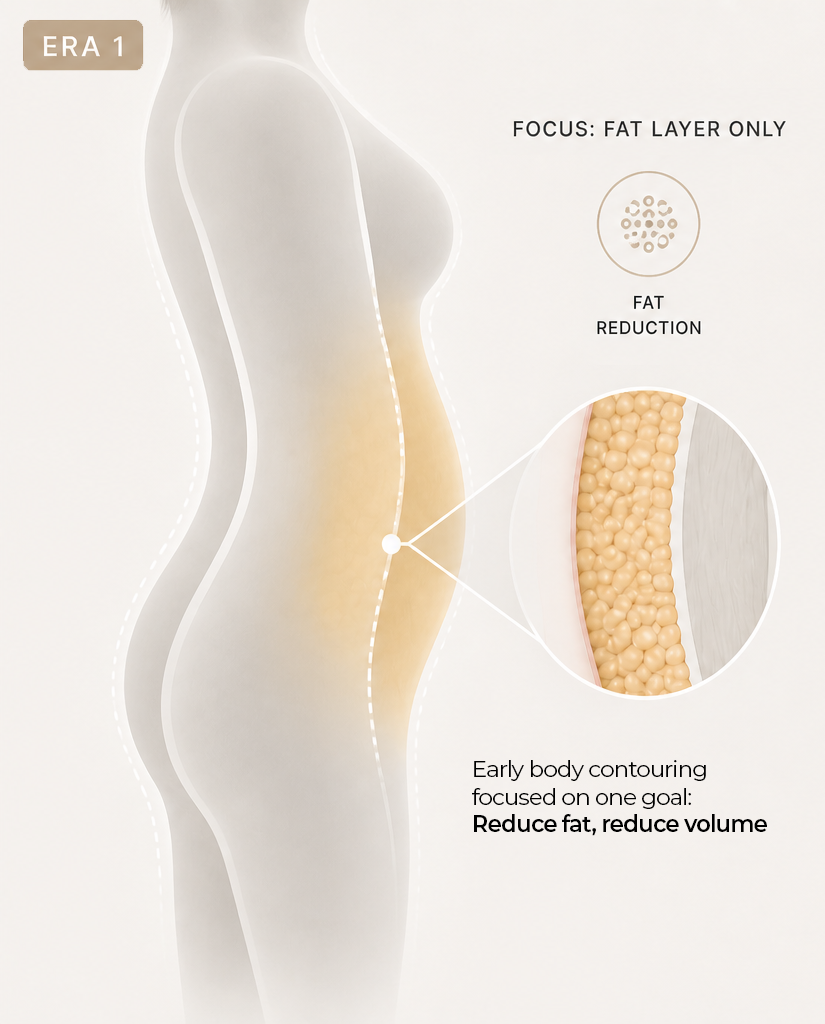
But a fat-only approach has always carried a hidden risk: the body can become smaller without becoming better.
Many patients eventually discovered the downside. When fat is reduced without improving underlying muscle activation or skin quality, the result can look softer than expected. In some cases, reduction reveals laxity, flattening, and loss of structural support. Patients may feel “deflated” rather than sculpted—especially in the abdomen, arms, inner thighs, and gluteal region.
Over time, providers noticed a consistent pattern: fat reduction can change volume, but volume alone doesn’t create definition. Definition is structural. And structure lives in muscle and tissue integrity.
Era 2: The Rise of Muscle Stimulation
The next phase of body contouring introduced a new promise: “build muscle while refining shape.” Muscle stimulation technologies expanded the category because they addressed something fat-only devices couldn’t—tone.

Patients loved the concept because it aligned with how people actually think about ideal results. A toned body looks athletic and supported. It looks younger. It looks intentional. And that look is driven as much by muscle activation as it is by body fat percentage.
But muscle stimulation alone has limitations too.
Muscle stimulation can strengthen and firm, but it doesn’t automatically address fat volume, skin laxity, or the quality of the tissue environment. In many cases, muscle tone improves but remains visually muted by the layers above it. Patients may feel stronger but still see softness. Or they may see improvement but wish it looked more refined, smoother, and tighter.
This created a new demand: a solution that treats the layers together, not separately.
Era 3: Multi-Modality Becomes the New Baseline
As the industry matured, multi-modality systems became more common. Instead of choosing between fat reduction and muscle stimulation, platforms began combining technologies—most often radiofrequency (RF) with some form of muscle activation.

This was a major step forward because RF could support tissue warming, collagen remodeling, and fat metabolism, while muscle stimulation improved tone and structural engagement. The logic was correct: the body is layered, so treatments should be layered too.
However, many multi-modality systems still left out a critical component: tissue engagement and clearance.
Even when fat cells are stressed and muscles are contracting, the body still needs to do something afterward. It must move fluid, clear metabolic byproducts, and maintain circulation. When that process is slow, results can look less refined. Patients may describe it as puffiness, softness, or a “not finished yet” look—even when change is occurring.
This is where the next evolution begins: not just stacking modalities, but supporting the body’s natural systems while those modalities do their work.
Era 4: Functional Restoration
Functional restoration is the new standard because it reflects what modern patients actually need.
This is especially true in the current market, where rapid weight loss—driven in part by the explosive adoption of pharmaceutical weight-loss therapies—has created a growing population of patients who are smaller but structurally compromised. The industry is now seeing more patients who present with muscle atrophy, skin laxity, and dissatisfaction with body shape even after significant weight reduction.

For these patients, fat reduction is not the missing piece. Restoration is.
Functional restoration focuses on four priorities:
Rebuilding muscle activation so the body looks and feels supported.
Improving tissue quality so tightening looks natural rather than forced.
Enhancing circulation and clearance so refinement happens efficiently.
Delivering sustainable results through repeatable, tolerable protocols and long-term maintenance strategies.
This is where MNML Tone fits within the evolution, not as another incremental device, but as a platform designed around the restoration model.
Why MNML Tone Represents the “Restoration Era”

MNML Tone is positioned as a 4-in-1 combination system integrating RF, EMS, vacuum therapy, and integrated cooling in a single platform. The purpose isn’t simply to treat more things—it’s to treat the body like the system it is.
A layered approach, delivered simultaneously
MNML Tone delivers 1 MHz bipolar RF for fat reduction and skin tightening and EMS up to 2,000 Hz for deep muscle activation, toning, and firming. In practical terms, this means the aesthetic goal isn’t “smaller.” It’s “stronger and more defined,” with tighter tissue support over the result.
The missing piece many systems don’t address: vacuum therapy

Vacuum therapy is included specifically for secure skin fixation and enhanced lymphatic flow, supporting engagement, circulation, and refinement as tissue adapts. The industry often underestimates how much lymphatic flow and circulation influence the visible “finish” of results. When tissue is engaged mechanically and fluid movement is supported, definition tends to show more clearly and settle more cleanly over time.
Comfort and safety that supports consistency
Integrated cooling is included to maintain comfort and safety during RF heating, which is critical for repeatability and patient tolerance. Consistency is what drives remodeling—especially for collagen response and neuromuscular adaptation.
A model built for sustainability, not one-off outcomes
A defining part of the restoration era is that body contouring is shifting toward programs and memberships rather than isolated treatments. The MNML TONE is explicitly positioned as a membership-driven approach built for trackable, sustainable outcomes and fewer operational barriers for providers.
This aligns with how patients behave today. They don’t just want a result. They want a rhythm that maintains the result.
The Real Shift: From “Reduction” to “Results That Hold”
When body contouring was only about fat reduction, the goal was a smaller area. When muscle stimulation entered the market, the goal became a firmer shape. When multi-modality became common, the goal became efficiency.
Now the goal is something more advanced: results that hold up over time.
That means results that remain stable through lifestyle fluctuations, aging, and the reality that most people won’t train at high intensity forever. It means results that look natural because the body’s structure is rebuilt instead of simply reduced.
It also means providers need tools that match modern patient realities—especially in a market increasingly influenced by rapid weight loss and its downstream effects on muscle, skin, and posture.
The Future of Body Contouring Is Restoration

Body contouring has evolved the same way every mature category evolves: from simple goals to complete outcomes.
Fat reduction was the beginning. Muscle stimulation raised the standard. Multi-modality improved efficiency. But functional restoration is where the category becomes truly modern—because it reflects what patients actually want and what biology actually requires.
MNML Tone sits in that restoration era by combining fat reduction, muscle activation, tissue engagement, and comfort-forward delivery in one hands-free platform.
Because the most convincing transformations don’t just remove volume. They rebuild structure—and give the body a reason to keep the result.



Comments