
Preventative Body Contouring: Why Waiting for Laxity Is the Wrong Strategy

Most people don’t think about body contouring until something changes.
A photo catches them off guard. A familiar outfit suddenly fits differently. The arms look softer than they remember. The abdomen doesn’t feel as stable. The glutes don’t “sit” the same way. And once those changes become obvious, the goal shifts from refinement to repair.
That’s the traditional model of aesthetics: wait until the problem is visible, then try to reverse it.
But the body doesn’t work that way.
Skin laxity, loss of tone, and contour flattening are rarely sudden events. They’re the end result of slow biological shifts—collagen decline, reduced muscle recruitment, tissue congestion, and structural support weakening over time. By the time those shifts become obvious, the tissue has often “settled” into its new baseline, making correction harder and slower than it needed to be.
This is why preventative body contouring isn’t a luxury concept. It’s the most realistic strategy for patients who want to look athletic, supported, and refined long-term.
The future of aesthetics isn’t about fixing late.
It’s about building early.
Why Laxity Gets Harder to Reverse Over Time
Patients often describe laxity as if it’s a surface issue—something the skin just “does.” But the visible loosening of tissue is usually a layered event, driven by changes happening beneath the surface.
Collagen quality declines with time
Collagen is not static. The dermal scaffold that keeps skin looking tight and resilient gradually becomes less dense and less organized. When that framework weakens, skin becomes less responsive to change.
That doesn’t mean tightening can’t happen. It means tightening works best when tissue still has the capacity to remodel efficiently.
Muscle loss removes the body’s internal structure
Muscle is not only “tone.” It’s support. Active muscle creates tension beneath the skin, which helps contours look lifted and stable. When muscle activation declines—whether through inactivity, aging, stress, or rapid weight loss—the body can look softer even without major fat gain.
This is why many patients feel frustrated when they’re not “overweight,” yet still don’t look defined. The issue isn’t just volume. It’s structure.
Tissue “settles” into its new default

As support decreases, the body adapts. Movement patterns shift. Posture changes. Certain muscle groups go quiet (especially core and glutes). The tissue environment becomes more stagnant. Once this becomes the new normal, reversing it requires more time and consistency than it would have earlier.
Preventative care works because it interrupts this settling process before it becomes the baseline.
The Preventative Model: Build, Support, Maintain
Preventative body contouring isn’t about chasing a dramatic change. It’s about maintaining a body that looks and feels “held up” over time—before the body starts signaling that something has been lost.
A preventive model focuses on three priorities:
1) Maintain muscle activation while life happens
Most people don’t lose tone because they “gave up.” They lose tone because life gets busier, movement becomes more repetitive, and deep recruitment patterns fade.
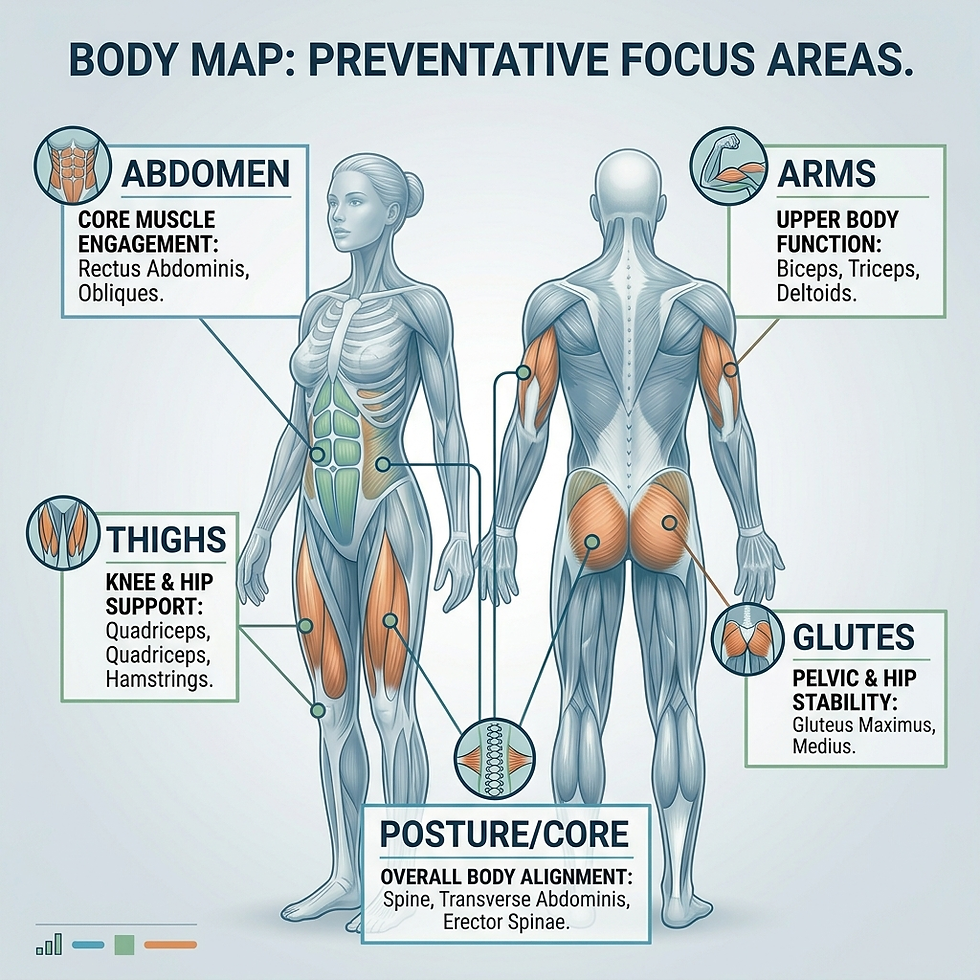
When muscle is consistently activated—especially in the areas that define silhouette (abdomen, glutes, thighs, arms)—the body is more likely to maintain shape even through stress, schedule changes, and lifestyle shifts.
2) Support tissue quality before laxity becomes visible
Skin tightening is often approached after laxity appears, but tissue quality is easier to maintain than to rebuild.
When the dermis is supported early—through consistent, controlled stimulation—the skin often remains more resilient through weight fluctuations, aging, and postpartum changes.
3) Promote circulation and fluid clearance as part of refinement
A refined body doesn’t just have less volume. It has better “finish.” Less congestion. Cleaner transitions. More definition.
Circulation and lymphatic movement influence this more than most patients realize. When fluid stagnates, contours blur. When tissue clears efficiently, definition appears more obvious—even when fat reduction hasn’t changed drastically.
Preventative care treats refinement as physiology, not cosmetics.
Who Benefits Most From Preventative Body Contouring
The biggest misconception is that preventative contouring is only for people who are already lean or “close to perfect.” In reality, prevention is most useful for people entering a phase of change—where the body is likely to shift faster than it can adapt.
GLP-1 patients early in the journey
GLP-1 medications can accelerate weight loss quickly. The earlier a patient supports muscle activation and tissue integrity, the less likely they are to end up with a smaller-but-softer outcome.
Preventative strategy here isn’t about doing “more.” It’s about protecting structure while fat reduction is happening.
Postpartum patients early in recovery
Many postpartum patients experience core instability and decreased muscle recruitment patterns, even years after delivery. Early support helps rebuild activation and stability before the body settles into compensation patterns that change posture and silhouette.
Aging patients (especially 30s–50s)
This is when muscle recruitment, collagen quality, and tissue circulation often begin shifting subtly. Patients may not feel “old,” but they notice softness and laxity appearing faster than it used to.
Preventative care here is not correction—it’s preservation of the athletic look.
Sedentary lifestyles (even at healthy weight)
Long periods of sitting quietly reduce glute and core activation. The body can look less lifted and less defined even when the scale is stable.
Prevention in this group is often the fastest way to restore shape without needing major fat reduction.
Why Waiting Creates the “Repair” Trap
When patients wait until laxity is obvious, they often fall into a repair mindset:
“I need tightening.”
“I need fat reduction.”
“I need something stronger.”
But the real need is usually layered:
muscle re-education
tissue quality support
circulation and fluid movement
posture and stability restoration
then refinement
This is why “fix it later” plans tend to take longer and feel more emotionally draining. Patients don’t just want a treatment—they want relief from the feeling that they’re sliding backward.
Preventative care reduces that anxiety because it keeps patients in a maintenance rhythm. Their body remains responsive instead of reactive.
Where MNML Tone Fits in Preventative Care
MNML Tone fits the preventative model because it addresses the layers that typically decline over time—muscle activation, tissue quality, and refinement—without requiring downtime or a drastic intervention mindset.
MNML Tone is a 4-in-1 system that combines:

RF (1 MHz bipolar RF) for fat reduction and skin tightening
EMS (up to 2,000 Hz) for deep muscle activation, toning, and firming
Vacuum therapy for secure skin fixation and enhanced lymphatic flow
Integrated cooling to maintain comfort and safety during RF heating
This matters preventatively because it allows patients to maintain structure and tissue quality consistently, rather than waiting until something becomes severe.
EMS: Preventing “quiet muscle”
One of the earliest signs of aging and inactivity is not visible weakness—it’s reduced recruitment. Muscles stop firing fully, especially in the core and glutes. MNML Tone’s EMS supports deep activation designed to rebuild tone and maintain muscular engagement over time.
RF: Supporting tissue resilience
Preventative tightening isn’t about dramatic lifting. It’s about maintaining a dermal environment that stays responsive. RF supports tissue quality and firmness so small changes don’t become large changes.
Vacuum: Refinement and fluid support
Vacuum is an under-discussed part of prevention. Over time, fluid stagnation and tissue congestion can blur definition, especially in the abdomen, thighs, and arms. MNML Tone’s vacuum therapy is designed for enhanced lymphatic flow and secure tissue engagement, supporting the refined “finish” that patients want to maintain.
Hands-free consistency
Preventative care works only if it’s sustainable. MNML Tone’s sessions are designed to be efficient (commonly ~30 minutes), with typical clinical cadence described as every 5–10 days in a series format.
That predictability makes it easier to build into membership models and maintenance rhythms rather than relying on one-off “fixes.”
What Preventative Results Actually Look Like
Preventative contouring is not about chasing a dramatic “before and after.” It’s about keeping the body from drifting into softness and instability.

Patients often notice:
the abdomen looks more stable because the core is more active
the glutes look more lifted because recruitment improves
arms and thighs look firmer because muscle tension returns
tissue looks less “puffy” because fluid movement is supported
posture looks more confident because the body is being held up again
This is why preventative care is often described as “looking the same—but better.” It doesn’t create a new body. It protects the best version of the current one.
A Simple Way to Explain Preventative Body Contouring to Patients
When patients ask, “Do I really need this if I’m not unhappy yet?” the best answer is honest:
You don’t need it to change everything.
You use it so everything doesn’t change without your permission.
Preventative body contouring is like strength training for aesthetics. You don’t do it because you’re broken. You do it because you want resilience—so the body stays supported through time, stress, weight fluctuation, and aging.
The Best Time to Support Tissue Is Before It Slips
Most aesthetic regret isn’t “I didn’t do enough.” It’s “I waited too long.”
By the time laxity is obvious, the body has already adapted to reduced activation, weaker tissue integrity, and slower refinement. Correction is still possible—but it’s harder, slower, and more emotionally loaded.
Preventative care flips the script. It keeps muscle active, supports tissue quality, and promotes refinement while the body is still responsive. And that’s why it consistently produces more natural-looking outcomes over the long run.
The best contouring strategy isn’t the one that fixes the most. It’s the one that prevents the need to fix in the first place.


Comments