
755nm, 808nm, and 1064nm: Why Wavelengths Matter in Laser Hair Removal

Laser hair removal can look simple from the outside. A patient comes in, the provider applies gel, the handpiece glides across the treatment area, and over time the hair becomes thinner, lighter, and less noticeable. But behind that smooth treatment experience is a lot of science.
One of the most important pieces of that science is wavelength.
For providers, wavelength is not just a spec on a brochure. It affects how laser energy interacts with the skin, the hair, and the follicle. It helps determine how deeply the energy travels, how strongly it is absorbed by pigment, and how flexible a device can be across different treatment areas and patient profiles.
That is why MNML Bare’s use of 755nm, 808nm, and 1064nm wavelengths matters. According to the MNML Bare Operator’s Manual, MNML Bare is a diode laser hair removal system that uses 755nm, 808nm, and 1064nm wavelengths, with adjustable fluence, frequency, multiple treatment heads, and contact cooling. The MNML Bare brochure also highlights these three wavelengths, along with 360° contact cooling, multiple treatment heads, and long-lasting hair reduction positioning.
For a modern aesthetic practice, those details are not just technical language. They help explain why the device can support a more flexible, provider-led approach to professional laser hair removal.
What Is a Laser Wavelength?
A laser wavelength describes the type of light energy being emitted by the device. It is measured in nanometers, abbreviated as nm. In laser hair removal, the wavelength matters because different wavelengths interact with tissue in different ways.
Some wavelengths are absorbed more strongly by melanin, the pigment found in hair and skin. Some wavelengths travel more deeply. Some may be better suited for certain treatment goals, skin types, or hair characteristics when used by a trained provider.
The simplest way to think about wavelength is this: it helps determine where the energy goes and how it behaves once it gets there.
Laser hair removal works by using light energy to target pigment in the hair shaft and follicle. The MNML Bare manual describes this process as a photothermal effect, where melanin absorbs laser energy and converts that light into heat. That heat damages the follicle and supports hair removal over time.
So when providers talk about wavelength, they are really talking about how laser energy reaches the target.
And the target is not the skin surface. The target is the follicle.
Why Wavelength Matters in Hair Removal
Hair removal is not just about applying heat. It is about applying controlled energy to the right target while minimizing unnecessary stress on the surrounding skin.
That balance is what makes wavelength important.
Hair follicles sit at different depths depending on the area of the body. Hair also varies dramatically from patient to patient. Coarse underarm hair behaves differently than fine facial hair. Dark leg hair is different from lighter arm hair. A patient with fair skin and dark hair presents a different treatment situation than a patient with a darker Fitzpatrick skin type or recent sun exposure.
This is where providers need flexibility. A device with multiple wavelengths gives a practice more range when building treatment plans. It does not mean every patient is treated the same way. It means the provider has more tools available when considering skin type, hair type, body area, treatment sensitivity, and patient tolerance.
MNML Bare’s three-wavelength approach gives providers access to 755nm, 808nm, and 1064nm energy in a professional diode laser platform. That combination is designed to support broader treatment flexibility than a single-wavelength approach.
But flexibility should never be confused with guesswork. The provider still needs to understand how wavelengths behave, how settings interact, and when to adjust treatment based on the patient in front of them.
The Role of 755nm
The 755nm wavelength is commonly associated with strong melanin absorption. In practical terms, that means it is highly interested in pigment. Since laser hair removal depends on targeting melanin in the hair shaft and follicle, this wavelength can be valuable when treating appropriate candidates with pigmented hair.

This is one reason 755nm is often discussed in relation to lighter or finer hair types, assuming there is still enough pigment for the laser to target. When the hair has visible pigment, melanin absorption becomes a useful part of the treatment strategy.
However, strong melanin absorption is also why providers need to be thoughtful. Melanin exists in the skin as well as the hair. If a patient has a darker skin type, recent tanning, or irritated skin, the provider must think carefully about energy selection and overall treatment safety. The goal is not simply to use the wavelength that absorbs the most pigment. The goal is to treat the follicle effectively while protecting the surrounding skin.
This is why consultation and skin typing are so important. A provider should never look at a wavelength in isolation. The wavelength is only one part of the treatment plan. Fluence, pulse duration, frequency, cooling, spot size, handpiece movement, patient feedback, and treatment area all matter.
MNML Bare supports professional use by giving providers adjustable parameters and treatment-head options, but the operator still has to make the right clinical decisions. The manual emphasizes that treatment parameters should be adjusted based on skin type, hair characteristics, and clinical guidelines.
That is the correct mindset for 755nm: powerful, useful, and highly dependent on proper patient selection.
The Role of 808nm
The 808nm wavelength is one of the most recognized wavelengths in diode laser hair removal. It is often considered a versatile option because it sits in a practical middle ground for professional hair reduction treatments.
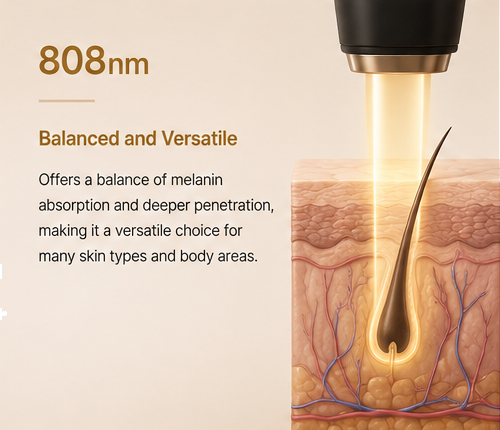
In many ways, 808nm is the workhorse wavelength people associate with diode laser technology. It has a strong history in aesthetic hair removal because it can deliver controlled energy to the follicle while supporting treatment across many common body areas.
For a provider, the value of 808nm is not that it replaces every other wavelength. Its value is that it can serve as a reliable foundation inside a broader treatment platform. Many patients coming in for underarms, legs, arms, chest, back, or bikini treatments may fall into treatment categories where 808nm diode energy is highly relevant.
When paired with the right fluence, appropriate pulse behavior, cooling, and treatment technique, 808nm can support efficient hair removal workflows. MNML Bare’s manual defines fluence as energy density and frequency as the laser shot or emission speed, both of which are adjustable across several treatment heads.
That adjustability matters because 808nm still needs to be customized. Treating a small facial area is not the same as treating a full back. Treating coarse hair is not the same as treating finer regrowth. Treating a first-time patient is not the same as treating someone who has already completed multiple sessions and tolerated prior settings well.
This is why 808nm works best in the hands of a trained provider who understands the full treatment picture. It may be a central wavelength in diode laser hair removal, but it still requires professional judgment.
The Role of 1064nm
The 1064nm wavelength is generally associated with deeper penetration and lower melanin absorption compared with shorter wavelengths. That makes it especially important in conversations about broader treatment flexibility.

Because 1064nm is less aggressively absorbed by superficial melanin than shorter wavelengths, providers often think about it when considering patients with darker skin types or situations where deeper energy delivery may be relevant. This does not mean that 1064nm automatically makes every treatment safe or appropriate. It means that the wavelength has characteristics that can support cautious, professional treatment planning in the right context.
This distinction matters.
A wavelength can support safer decision-making, but it cannot replace the provider’s responsibility. The provider still has to assess the patient, review contraindications, perform a patch test when appropriate, monitor cooling, adjust parameters, and respond to skin feedback.
The MNML Bare manual repeatedly reinforces the importance of patient assessment. It instructs providers to review medical history, prior treatment records, and contraindications before treatment. It also notes that patients with recently tanned or severely sun-damaged skin should delay treatment until recovery.
That is especially important when discussing 1064nm. Providers should not treat it as a shortcut around screening. It is part of the treatment toolbox, not a replacement for clinical caution.
For practices, having 1064nm available alongside 755nm and 808nm can make the device more versatile. It gives providers more technical range when working with different hair depths, skin types, and treatment needs. But the safest approach is still the same: evaluate first, treat second.
Why a Multi-Wavelength Platform Gives Providers More Flexibility
A single wavelength can be useful. A multi-wavelength platform can be more flexible.
That is the practical advantage of MNML Bare’s 755nm, 808nm, and 1064nm design. Each wavelength brings different characteristics to the treatment environment. One may offer stronger melanin absorption. Another may serve as a versatile diode standard. Another may support deeper treatment considerations and broader skin-type planning.
For a busy aesthetic practice, this matters because patients rarely fit into neat categories.
One patient may be coming in for coarse underarm hair. Another may want bikini treatments. Another may be treating arms or legs. Another may have darker skin and require a conservative approach. Another may have lighter hair that needs a more careful consultation about expectations. The more diverse the patient base, the more valuable flexibility becomes.
MNML Bare also supports that flexibility with exchangeable spot sizes and multiple treatment heads. The manual describes the treatment handle as equipped with interchangeable heads, and the brochure promotes exchangeable spot size as a feature designed to help providers target different body areas.
This is important because wavelength is not the only thing that changes from treatment to treatment. Area size matters too. Larger areas like legs, back, and chest need efficient coverage. Smaller areas like the face, upper lip, fingers, and hairline require more precision. The ability to change spot size helps the provider match the device setup to the area being treated.
In other words, MNML Bare is not just built around multiple wavelengths. It is built around treatment flexibility.
Wavelengths Are Only Part of the Equation
It is easy to focus on wavelengths because they sound impressive. And they are important. But wavelength alone does not determine treatment quality.
Laser hair removal depends on the interaction of several factors. The provider must consider energy density, pulse timing, treatment speed, cooling, spot size, skin type, hair type, body area, and the patient’s real-time feedback.
Fluence is one of the most important settings. It refers to the amount of energy delivered over a specific area. The MNML Bare manual lists adjustable fluence ranges for different treatment heads, including 3–36 J/cm², 5–50 J/cm², and 9–80 J/cm² depending on the selected spot size.
Frequency also matters. Frequency refers to the speed of laser emissions, measured in Hz. A higher frequency can support faster treatment movement, but speed must be matched with technique. Moving too quickly may reduce consistency. Moving too slowly or overlapping too much may increase the risk of irritation or burns.
Pulse duration is another major factor. The MNML Bare manual explains that pulse duration changes as fluence and frequency are adjusted. This means the provider should understand that settings are connected. Changing one parameter can affect the behavior of the overall treatment.
Cooling is equally important. The MNML Bare brochure highlights 360° contact cooling, and the operator’s manual instructs providers to wait until the treatment head reaches below 0°C before starting treatment. Cooling can support comfort and epidermal protection, but it does not replace proper settings or trained operation.
The best way to think about wavelengths is this: they are the foundation, not the whole building.
Why Providers Should Avoid a One-Size-Fits-All Treatment Approach
One of the biggest mistakes in laser hair removal is treating every patient the same way.
Two patients can request the same treatment area and still require different plans. One may have coarse black hair and fair skin. Another may have finer brown hair and a darker skin tone. One may have had recent sun exposure. Another may have a history of sensitivity. One may tolerate the treatment easily.
Another may need a slower, more conservative session.
The treatment area itself also changes the equation. Underarms, upper lip, bikini, legs, chest, back, and arms all have different sensitivities, hair densities, contours, and patient expectations. A setting that makes sense for one area may not make sense for another.
That is why MNML Bare’s manual emphasizes patient assessment, parameter selection, pre-treatment setup, intra-treatment monitoring, and post-treatment care. It also recommends skin testing, especially for first-time patients or those with higher Fitzpatrick skin types IV–V.
Patch testing is one of the simplest examples of professional judgment. A provider treats a small area, observes the response, and uses that information before treating a larger zone. It is not glamorous, but it is an important safety step.
Laser hair removal should be customized, documented, and adjusted over time. The provider should consider the patient’s response at every visit. If the patient had excessive redness last time, the plan may need to change. If the patient tolerated treatment well but had minimal follicular response, the provider may reassess settings within safe guidelines. If the patient arrives with a tan, the treatment may need to be delayed.
A good provider does not just know how to use a laser. They know when not to use it.
How Wavelength Education Helps Patients Trust the Process
Patients do not need a physics lecture before every treatment, but they do appreciate clear explanations. When providers can explain why a device uses multiple wavelengths, patients better understand that laser hair removal is a professional treatment rather than a generic beauty service.
A simple explanation can go a long way.
A provider might explain that MNML Bare uses three wavelengths to support flexible treatment planning across different hair types, skin types, and treatment areas. They might explain that laser energy targets pigment in the hair follicle and that treatments are spaced out because hair grows in cycles. They might also explain that the provider will adjust settings based on the patient’s skin, hair, comfort, and response.
This kind of education builds trust. It helps patients understand why consultations matter, why they need multiple sessions, why sun exposure can delay treatment, and why aftercare is important.
It also helps set realistic expectations. Laser hair removal is best discussed as long-term hair reduction, not an instant one-treatment solution. The MNML Bare manual states that treatments are typically performed in 6–8 sessions spaced 4–6 weeks apart, depending on the hair growth cycle. That is information patients should understand before starting.
When patients know what to expect, they are more likely to complete their series and feel satisfied with the process.
The Provider Takeaway
Wavelengths matter because they shape how laser energy behaves in the skin and around the hair follicle. In professional laser hair removal, that matters every single day.

MNML Bare’s combination of 755nm, 808nm, and 1064nm wavelengths gives providers a flexible diode laser platform for hair reduction treatments. The 755nm wavelength is commonly associated with strong melanin absorption. The 808nm wavelength is a widely used diode hair removal wavelength with broad treatment relevance. The 1064nm wavelength supports deeper treatment considerations and can be relevant when providers are thinking about darker skin types or more conservative energy delivery.
Together, these wavelengths help providers adapt to different treatment areas, hair types, and patient profiles. But they do not replace training. They do not replace screening. They do not replace patch
testing, cooling, proper technique, documentation, or aftercare.
The strongest laser hair removal outcomes come from combining the right technology with the right provider judgment.
That is where MNML Bare fits into a modern aesthetic practice. It gives providers multi-wavelength diode technology, contact cooling, interchangeable treatment heads, and adjustable parameters in one professional platform. For practices that want to offer laser hair removal with flexibility and structure, that combination matters.
Interested in bringing multi-wavelength diode laser hair removal to your practice? Contact MNML Aesthetics to learn more about MNML Bare, training, service, and device availability.

Comments